


How Virtual Assistants Are Transforming Business Process Optimization
Businesses are under constant pressure to improve productivity, reduce operating costs, respond faster to customers, and focus internal teams on high-value work. At the same time, employees often spend significant time managing repetitive administrative activities that do not directly contribute to strategic growth. Virtual assistants offer a practical way to address this challenge by providing remote support for routine, administrative, customer service, and operational tasks.
The growing adoption of virtual support reflects a broader shift toward flexible and technology-enabled business operations. Instead of expanding internal teams for every operational requirement, companies can use trained virtual professionals to handle defined processes and workloads.
What tasks can businesses delegate to virtual assistants?
Common tasks include scheduling, email management, data entry, research, customer follow-ups, documentation, reporting, and administrative coordination.
The Role of Virtual Assistants extends beyond basic administrative support. When properly integrated into business workflows, virtual assistants can help standardize processes, improve turnaround times, support customer communication, and free employees to concentrate on activities requiring specialized expertise and decision-making.
For organizations evaluating outsourcing and process optimization strategies, virtual assistants can become a valuable component of a scalable operating model.
The Strategic Role of Virtual Assistants in Streamlining Business Operations
Virtual assistants can support multiple business functions depending on an organization’s requirements. Their value is particularly relevant when companies identify repetitive processes, administrative bottlenecks, or capacity constraints that can be handled remotely.
The Virtual Assistants in Business Process Optimization approach focuses on assigning suitable tasks to trained professionals while maintaining clear workflows, quality standards, security controls, and performance measurement.
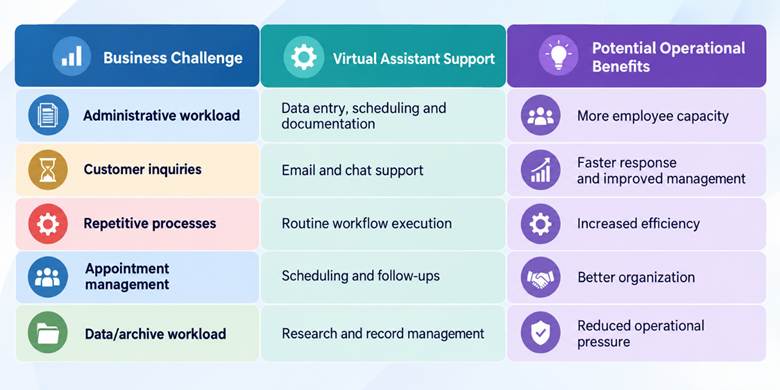
1. How Virtual Assistants Improve Business Process Efficiency
Process efficiency starts with identifying where time and resources are being consumed unnecessarily. Virtual assistants can take responsibility for repeatable tasks that follow clearly defined procedures.
For example, a business may delegate:
- Calendar and appointment management
- Email organization and responses
- Data entry and database updates
- Document preparation
- Online research
- Customer follow-ups
- Basic reporting and administrative coordination
By assigning these activities to dedicated virtual professionals, internal employees can spend more time on strategic planning, sales, technical work, client relationships, and other high-value responsibilities.
A successful approach requires clearly documented workflows, defined responsibilities, quality checks, and measurable service-level expectations. Virtual assistants should complement—not replace—the processes and expertise that are critical to the organization’s core operations.
2. Reduce Business Costs With Virtual Assistant Services
Cost management is one of the key reasons companies consider virtual assistance. Traditional hiring can involve recruitment, onboarding, workspace, equipment, benefits, training, and other employment-related expenses.
What business expenses can virtual assistants help reduce?
They can reduce costs related to recruitment, onboarding, workspace, equipment, benefits, training, and other employment-related expenses.
Virtual assistant services can provide an alternative model in which businesses obtain support based on their workload and operational requirements.
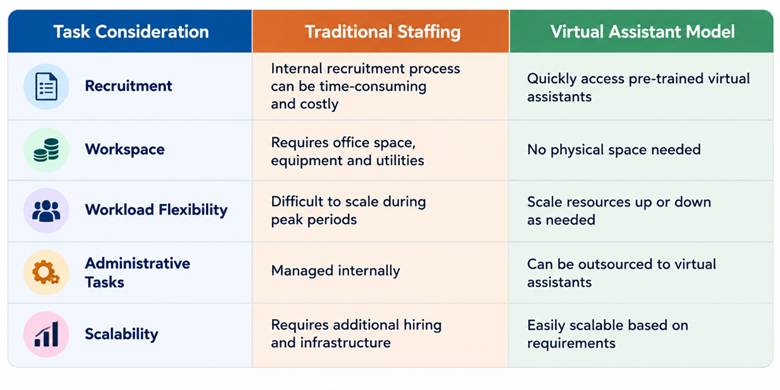
The actual financial benefit depends on the provider, location, engagement model, workload, and task complexity. Businesses should therefore evaluate total value rather than comparing hourly rates alone.
Important factors include service quality, reliability, data protection, communication, supervision, and measurable outcomes.
3. Automate Repetitive Tasks and Save Valuable Time
Virtual assistants and automation can work together to improve operational efficiency. While automation can handle rule-based digital workflows, virtual assistants can manage tasks requiring human judgment, communication, verification, or exception handling.
For example, an automated system may generate customer notifications, while a virtual assistant reviews responses and handles cases requiring human interaction.
This combination can support:
- Faster task completion
- Reduced manual workload
- Better process consistency
- Human oversight of automated workflows
- Improved handling of exceptions
The Role of Virtual Assistants in BPO can therefore extend into hybrid workflows where people and technology work together rather than treating outsourcing and automation as separate strategies.
4. Scale Business Operations With On-Demand Virtual Support
Business workloads can fluctuate because of seasonal demand, marketing campaigns, new customer acquisition, product launches, or temporary projects. Hiring permanent employees for every increase in workload may not always be practical.
Virtual assistants can provide additional operational capacity without requiring businesses to immediately build larger internal departments.
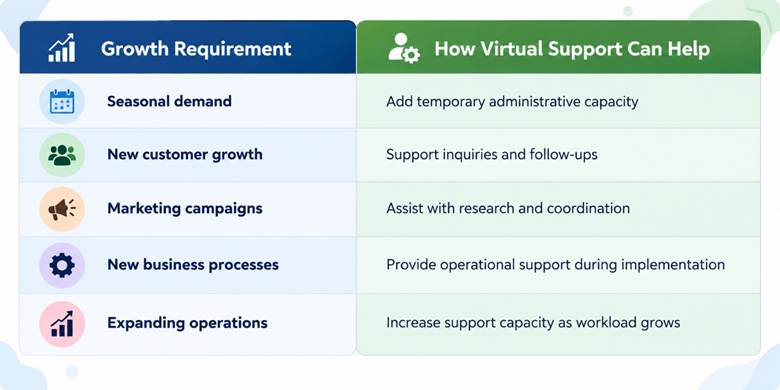
This flexibility can be particularly valuable for startups, growing companies, and established organizations restructuring their operating models.
However, scalability should be supported by proper training, documentation, access controls, and performance monitoring. Increasing headcount without process discipline can create additional complexity rather than solving it.
5. Improve Productivity and Customer Experience With Virtual Assistants
Customer experience often depends on operational details: responding to inquiries, scheduling appointments, following up on requests, maintaining accurate information, and ensuring that tasks are completed on time.
What customer service tasks can virtual assistants handle?
They can manage inquiries, follow-ups, scheduling, information updates, and other defined customer-support activities.
Virtual assistants can support these activities while internal teams focus on complex customer needs and strategic responsibilities.
A customer-focused virtual assistant program should prioritize:
- Clear communication standards
- Consistent response procedures
- Data accuracy
- Timely follow-ups
- Escalation procedures
- Quality monitoring
- Customer privacy and information security
For businesses, the value is not simply having someone complete administrative tasks. The greater opportunity is creating a reliable support layer that contributes to smoother customer interactions and more productive internal teams.
Build a Smarter, More Efficient Business With Virtual Assistants
The Role of Virtual Assistants continues to evolve as businesses seek more flexible and efficient ways to manage operations. From administrative support and customer communication to repetitive workflows and back-office processes, virtual assistants can help organizations allocate resources more effectively.
The strongest results come from selecting the right tasks, establishing documented workflows, defining measurable performance expectations, and choosing a service provider that takes security, quality, communication, and accountability seriously.
For businesses considering virtual assistance, the starting point should be a clear assessment of operational bottlenecks and tasks that can be safely and effectively delegated.
MedVoice Global can help businesses explore structured virtual support solutions aligned with their operational requirements. Contact MedVoice Global to discuss your business processes, identify suitable outsourcing opportunities, and build a scalable support model designed around your goals.
Frequently Asked Questions
1. What is the role of virtual assistants in business process optimization?
Virtual assistants support businesses by handling defined administrative, operational, customer service, and repetitive tasks. This can help improve workflow efficiency and allow internal employees to focus on higher-value responsibilities.
2. How do virtual assistants reduce business costs?
Virtual assistants can help reduce certain staffing and operational expenses by providing remote support without requiring businesses to maintain additional office resources for every operational role. Savings vary according to the engagement model and scope of work.
3. What tasks can businesses delegate to virtual assistants?
Common tasks include scheduling, email management, data entry, research, customer follow-ups, documentation, appointment coordination, basic reporting, and other repeatable administrative processes.
4. How are virtual assistants different from automation?
Automation performs predefined digital actions with limited human involvement, while virtual assistants provide human support and can manage communication, judgment-based activities, verification, and exceptions. The two can also be combined in hybrid workflows.
5. How can businesses choose the right virtual assistant service?
Businesses should evaluate relevant experience, communication capabilities, security practices, quality controls, scalability, pricing transparency, training processes, and performance measurement before selecting a virtual assistant service provider.